
Once you have a child, you start looking at everyday things differently. Mealtimes feel a little higher stakes. A cough gets your attention faster. You notice how quickly a normal afternoon can turn stressful when a baby is gagging, struggling to breathe, or suddenly goes quiet in a way that does not feel right.
That is part of what makes CPR feel so important to parents. Not because anyone wants to imagine the worst, but because those moments can happen fast, and knowing what to do can make all the difference.
A lot of people are surprised to learn that CPR is not exactly the same for everyone. The goal is still to keep blood and oxygen moving until help arrives, but the way you respond to a baby is different from the way you would respond to an adult.
That is one reason so many parents start looking into CPR certification Miami options after having a baby or taking on more caregiving responsibilities. It is not about expecting something bad to happen. It is about wanting to feel a little more prepared and a little less powerless if it ever does.
Why it Helps to Know CPR Before Your Child Needs It
Most parents do not really imagine themselves doing CPR. It is one of those things you hope stays in the category of “good to know, probably never use.”
But if something does happen, it matters right away.
In an emergency, there is no perfect pause where you get to gather yourself, search for a video, and double-check the steps. Things move fast. Training helps because it gives you something to fall back on when your brain is stressed and your heart is racing.
It also helps to know that babies and adults usually need CPR for different reasons. With adults, it is often tied to a sudden heart problem. With infants, it is more likely to start with breathing trouble, choking, drowning, or something else that affects oxygen first.
That is why CPR can be so valuable for anyone caring for a child, not just parents, but grandparents, babysitters, nannies, and other caregivers too. Some families also sign up for first aid classes Miami parents trust because they want to feel more prepared in general, not only for the biggest emergencies. Even a basic understanding can make those first few minutes feel a little less overwhelming while help is on the way.
Is Infant CPR the Same as Adult CPR?
The short answer is no, but it helps to understand why. Infants have much smaller bodies, more delicate bones, and smaller lungs. Their emergencies also tend to happen for different reasons. Because of that, CPR for an infant has to be gentler and more precise.
Adult CPR usually requires stronger chest compressions using the heel of your hand, and sometimes both hands, depending on the size of the person. Infant CPR uses much less force and different finger placement because pressing too hard can cause harm.
The breathing part is also different. With an infant, the breaths you give are much smaller and gentler. You are not trying to blow in a large breath. You are simply trying to make the chest rise. Choking care is different too, which is something many parents do not realize until they take a class.
So while the purpose of CPR is similar for every age group, the technique is not interchangeable. This is one reason parents often search for Miami CPR classes that specifically include infant, child, and adult CPR in the same training.
What Makes Infant CPR Different From Adult CPR?
At a glance, infant CPR and adult CPR can seem pretty similar. In both cases, you are trying to keep blood and oxygen moving until help arrives. But once you get into the actual steps, the differences are important.
A baby is not just a smaller adult. Their chest is smaller, their lungs are smaller, and their body is a lot more delicate. That means the technique has to change too. The biggest differences come down to how deep you press, where your hands go, how you give breaths, and what you do if the person is choking.
Those details are exactly why parents should learn infant CPR on its own terms, not just assume regular CPR knowledge covers it.
How Deep Should Chest Compressions Be for Infant CPR vs Adult CPR?
This is one of the first differences people notice, and honestly, it is one of the parts that makes parents the most nervous.
The thought of pressing on a baby’s chest can feel scary at first. Most people worry about pressing too hard. That makes sense. But in an emergency, the goal is still to give effective compressions, not hold back so much that they do not help.
For an infant, compressions should be about one third the depth of the chest, which is roughly 1.5 inches. For an adult, they need to be deeper, at least 2 inches. So yes, infant CPR is gentler, but it still needs to be done with purpose.
The speed stays about the same, usually 100 to 120 compressions per minute. So the rhythm is similar. What changes is the force behind it.
That is one reason practice helps so much. Reading a number on a page is one thing. Getting a feel for what that amount of pressure actually means is something else.
Where Should Your Hands Go During Infant CPR vs Adult CPR?
Hand placement is another area where the difference is really obvious.
With adult CPR, the movement is bigger and stronger. With infant CPR, it is much more controlled. You are working with a much smaller chest, so even the way you position your hands has to change.
Hand Placement for Adult CPR
For an adult, you place the heel of one hand in the center of the chest on the lower half of the breastbone. Then you put your other hand on top and press straight down.
That position works because an adult chest needs more force. You are using a broader hand placement to create strong, effective compressions.
Hand Placement for Infant CPR
For an infant, the placement is much smaller and more precise. If there is one rescuer, two fingers usually go in the center of the chest just below the nipple line. If there are two rescuers, many classes teach the two-thumb encircling technique, where both hands wrap around the baby’s chest and the thumbs do the compressions.
That can sound technical when you read it, but the main point is simple: you do not use the same hand position on a baby that you would use on an adult.
And that matters. Proper hand placement helps the compressions do what they are supposed to do while also lowering the chance of causing injury.
Are Rescue Breaths Different for Infant CPR and Adult CPR?
Yes, they are, and this is another place where people are often surprised by how gentle infant CPR needs to be.
With an infant, the breaths are small. You usually cover both the baby’s mouth and nose with your mouth to create a seal, then give a soft breath that is just enough to make the chest rise. Not a big breath. Not a forceful one. Just enough.
With an adult, the process is different. You tilt the head back, lift the chin, pinch the nose, and breathe into the mouth until the chest rises. Since an adult has much larger lungs, the amount of air is naturally greater.
A lot of parents assume rescue breaths will be the easy part, but they can actually take some practice with an infant. Too much air is not good, and too little may not do much. That is part of why hands-on training can feel so helpful. It takes something that sounds abstract on paper and makes it feel more manageable.
How Is the Choking Response Different for Infants and Adults?
This is probably one of the most important differences for parents to know because choking is one of the emergencies families are most likely to face.
If an adult is choking, most people immediately think of abdominal thrusts. But that is not what you do with an infant. Babies should not receive abdominal thrusts. Instead, choking care for an infant typically involves back slaps and chest thrusts, done carefully and in the correct order.
That difference matters a lot. Babies put everything in their mouths, and even parents who are careful about feeding and supervision can end up with a scary moment out of nowhere.
Knowing that the choking response is different for infants helps you react faster and with a little more confidence. It also reminds parents that infant CPR is its own skill set. It is not just adult CPR scaled down.
Can an AED Be Used on an Infant?
Most parents do not realize an AED might be used for an infant too.
When people hear “AED,” they usually picture an adult collapsing in a public place, not a baby in an emergency. So this part can feel surprising. But yes, in some situations, an AED may be used on an infant.
If pediatric pads are available, those are the best option. If they are not, the device will still give step-by-step prompts, which is helpful because no one is at their calmest in a moment like that.
Parents do not need to become experts on AEDs or memorize every little detail. The important thing is simply knowing that an AED is not automatically ruled out because the person needing help is a baby. If one is nearby, it may be part of the response along with CPR.
And even though most families will never keep one at home, they are in more places than people think, schools, airports, gyms, churches, office buildings, community centers. That is part of why CPR training helps so much. It makes all of this feel a little more familiar, which can make a scary situation feel slightly less overwhelming.
Why Hands-On Training is So Important
Reading about CPR helps, but it is not the same as actually practicing it.
A lot of things sound clear when you are calm. They make sense when you are sitting on the couch, reading through the steps. But emergencies do not feel calm. When your adrenaline kicks in, even simple things can suddenly feel harder to remember than you expected.
That is why practice matters so much. It helps turn the information into something more familiar. You are not only hearing what to do. You are getting a feel for it, where your hands go, how hard to press, what the rhythm feels like, how to stay focused when everything feels urgent.
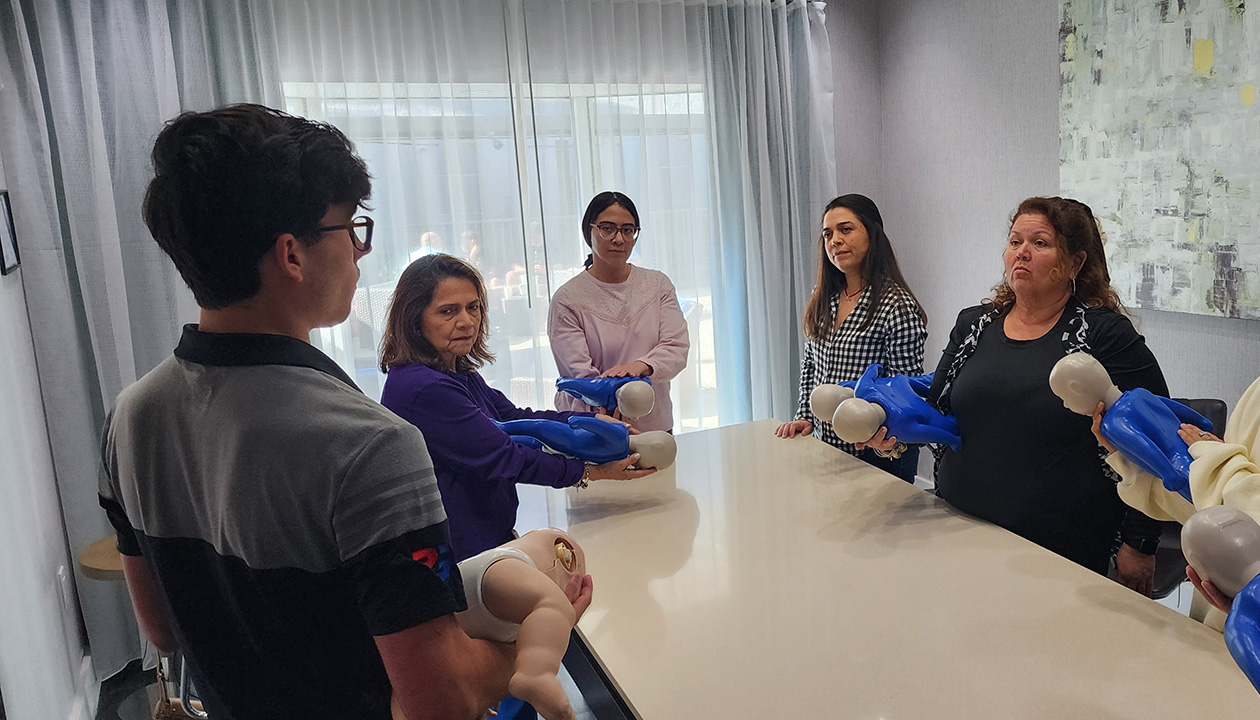
That is often what makes training click for parents. Once they have practiced compressions, rescue breaths, and choking response with an instructor, it all feels a little more real and a lot less intimidating.
For families looking at Miami CPR classes, that can be the deciding factor. It is not only about learning the information. It is about leaving class feeling like you could actually step in and help if you needed to.
Should Parents Choose In-Person Training or Virtual CPR Training Miami?
It really comes down to what works best for your life.
Some parents feel better learning in person, especially if this is their first time taking a CPR class. There is something reassuring about having someone right there to show you what to do, answer questions, and help you practice until it starts to feel more comfortable. If you are unsure about things like hand placement, compressions, or rescue breaths, that kind of feedback can make a big difference.
At the same time, virtual CPR training Miami options can be a much better fit for parents whose schedules already feel packed. A lot of families are trying to fit everything into the same week, work, school, errands, childcare, sports, all of it. Learning online can make CPR training feel a lot more doable.
In the end, the best option is usually the one you will actually follow through on. For some people, that is an in-person class. For others, it is starting online, getting comfortable with the material, and then practicing the hands-on part after that.
Online First Aid Classes Miami Parents Can Take From Home
Parents often want to learn life-saving skills but struggle to find the time for a traditional classroom schedule. That’s where online first aid classes Miami families can access from home become appealing. They give busy caregivers a way to start learning without adding another major logistical challenge to the calendar.
The key is understanding what the course includes. Some online classes are designed for general awareness and education. Others are part of a larger certification path. Parents should pay attention to whether the class includes practical skills testing, whether it meets workplace requirements, and whether it covers infant and child emergencies in enough detail.
For a household that simply wants more confidence and preparedness, online learning can be a very practical step. It is not about choosing the perfect format. It is about choosing a format that helps you begin.
Blended Learning CPR for Miami Families
For a lot of parents, this ends up being the option that makes the most sense.
Blended learning CPR gives you some flexibility without asking you to learn everything on your own. Usually, that means you go through the course material online first, then come in later for the hands-on part. So you can learn the basics at home, on your own schedule, and still get real practice with an instructor.
That balance is what makes it work for so many families. You do not have to clear a huge block of time for one long class, but you are also not skipping the part where you actually practice compressions, breathing skills, and technique.
For parents, that can feel like a good middle ground. You get the convenience of online learning, but you still have the chance to ask questions, get corrected, and leave feeling more sure of yourself.
Some families look specifically for blended learning CPR certification because they want something that feels both practical and manageable. It can be a really solid option for parents who want flexibility but do not want to miss the hands-on side of training..
How to Choose the Right CPR Certification Miami Class for Your Family
Not every class is the right fit for every parent, so it helps to think about what matters most to your household.
Start by looking at what the course actually covers. If you are a parent or caregiver, make sure infant and child CPR are included, not just adult CPR. It is also worth checking whether choking care and AED basics are part of the training.
Then think about format. Some families learn best in person. Others prefer virtual or blended options because of their schedules. Cost, location, class size, and teaching style all matter too.
When comparing a CPR certification Miami course, it helps to ask practical questions. Will this class leave me feeling more confident? Does it fit the way I learn best? Will I get to practice the techniques? Those questions are often more useful than simply looking at a course title.
Where Can Parents Find First Aid Classes Miami Families Feel Good About
Parents do not need a course that overwhelms them with technical jargon. They need training that explains what to do in a clear, calm way and gives them a chance to practice. A good class should leave you feeling more capable, not more anxious.
That is why many families look not only for CPR classes, but also for broader first aid classes Miami providers offer. Basic first aid knowledge can complement CPR training and help parents feel more prepared for the kinds of everyday emergencies that happen with children.
Some families may also prefer an online first aid and CPR course South Florida option if scheduling is tight or if they want to begin learning from home. For others, an in-person setting feels more supportive. There is no single right path. What matters most is choosing a class you trust and completing it.
The Best Time to Learn CPR is Before You Need It
The differences between infant CPR and adult CPR are not just technical details. They are practical, important differences that affect how you respond in a real emergency. The depth of compressions changes. Hand placement changes. Rescue breaths change. Choking care changes. And for parents, those details matter.
The good news is that you do not need to be a healthcare professional to learn these skills. You just need the willingness to prepare before the moment arrives. Whether you choose in-person training, blended learning CPR, or another flexible option for CPR in Miami, the most important step is getting started.
For many parents, CPR training brings more than education. It brings peace of mind. It helps you feel a little more steady in a world where not everything can be predicted. And if an emergency ever does happen, that preparation could make all the difference.