
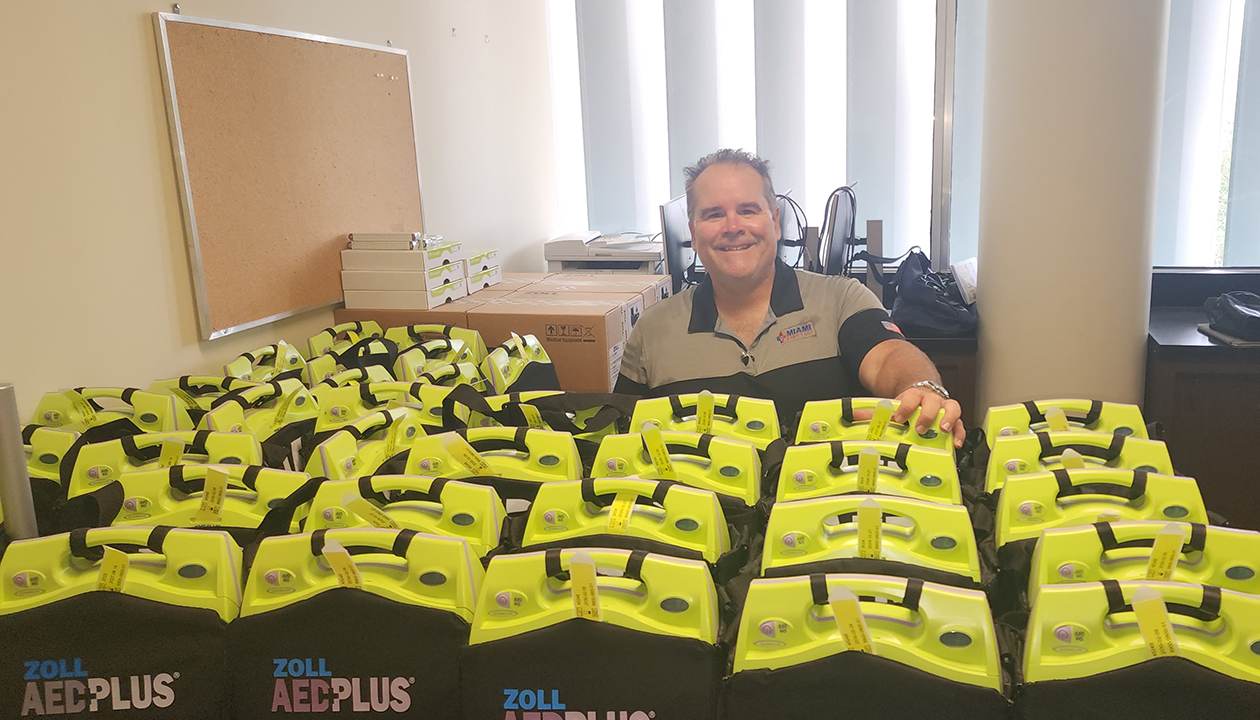
Most business owners do not think much about an AED until they imagine a real emergency. Someone collapses at work. People panic. Then the questions start all at once.
Do we have an AED? Does it work? Would anyone here know what to do?
That’s why this topic is so critical.
In Florida, there is not a one-size-fits-all rule requiring every private employer to keep an AED in the workplace. But once a business chooses to have one, the conversation gets bigger than the device itself. Training, maintenance, and emergency response all matter. Florida law encourages AED training, encourages owners to notify local EMS of the device location, and requires EMS to be activated as soon as possible after the AED is used. Liability protection is also tied to meeting certain operational requirements.
Are AEDs Required In Every Florida Workplace?
Usually, no.
For many offices, retail businesses, and small employers, Florida does not have a blanket law saying an AED must be on site. That is the part many employers want clarified first. The state encourages businesses to obtain an AED, but it does not generally force every business to do so.
That said, “not required” does not always mean “not important.” A lot of employers end up looking into AED services in Miami, not because they are trying to check a box, but because they want to know their workplace is prepared if something serious happens.
What Florida Employers Should Know Before Adding An AED
Buying an AED is the easy part.
What often gets overlooked is everything that comes after. If a business has an AED, someone needs to make sure it is ready to use, easy to find, and part of an actual response plan. That includes staff awareness, EMS activation, and regular upkeep. Florida’s legal protections for AED owners and users are not unlimited. They depend on compliance with the state’s administrative and operational requirements around the program.
That is why many employers pair an AED program with AED training Miami and corporate CPR training Miami. In a real emergency, the goal is not just having the device on the wall. It is having people nearby who feel calm enough to use it.
Why Miami AED Maintenance Matters More Than Employers Expect
This is where a lot of businesses get caught off guard.
Pads expire. Batteries need to be checked. Devices cannot just sit there for years and be assumed ready. If an AED is part of your workplace safety plan, maintenance has to be part of the plan too. For many businesses, that is why AED Miami maintenance becomes just as important as the initial purchase.
From a practical standpoint, employers usually do better when AED planning is treated as part of broader Workplace Safety Training Miami efforts, not as a separate item that gets forgotten after installation.
Which Florida Workplaces Have More Specific AED Rules?
Some Florida workplaces do face more specific requirements.
Public schools that are members of the Florida High School Athletic Association must have an operational AED on school grounds for athletic activities. Florida also has AED requirements in dental offices through state regulation, and certain assisted living facilities must have a functioning AED on the premises.
That matters because some employers assume AED laws either apply to everyone or to no one. In reality, Florida sits somewhere in the middle.
How Employers Can Build A Smarter Workplace AED Program
For most employers, the better question is not “Are we required to have one?” It is “Would we be ready if someone collapsed here tomorrow?”
That is where a smarter AED program starts. Make sure the device is maintained. Make sure employees know where it is. Make sure someone has training. And make sure AED planning fits into your larger corporate safety training Miami strategy.
That kind of preparation feels a lot more useful than scrambling in the middle of an emergency.